
How Reliable is AI when Providing Financial Advice
Artificial Intelligence (AI) has rapidly become part of everyday life, helping people answer questions, compare products, research investments and make financial decisions. For younger generations in particular, AI tools can feel like a natural and convenient source of information. With instant responses and easy-to-understand explanations, it is no surprise that many investors are turning to AI before seeking guidance elsewhere. However, as AI becomes more influential in financial decision-making, an important question remains: how reliable is it when providing financial advice?
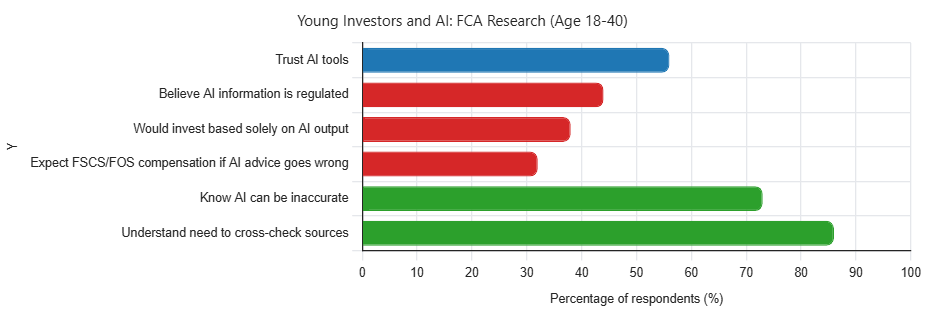
Recent research highlighted by FT Adviser revealed that almost half (44%) of young investors wrongly believe that AI-generated financial information is regulated. The findings, based on research conducted by the Financial Conduct Authority (FCA), suggest that many younger investors may overestimate the protections available when relying on AI tools. The study also found that 32% incorrectly believed they would be entitled to compensation through the Financial Services Compensation Scheme (FSCS) or Financial Ombudsman Service (FOS) if AI-generated advice led to losses.
The attraction of AI is easy to understand. It can explain financial concepts in plain English, help users compare investment options, summarise market news and provide educational content in a matter of seconds. For young investors who may be at the beginning of their financial journey, AI can help bridge knowledge gaps and make investing appear more accessible. Research from the FCA found that 56% of younger investors trust AI tools, a higher level of trust than that placed in television, radio, newspapers, or social media influencers.
Despite these benefits, AI has significant limitations when it comes to financial advice. Most publicly available AI tools are not authorised or regulated to provide personalised investment recommendations. While they can provide general information, they do not fully understand an individual's circumstances, goals, attitude to risk, tax position, or capacity for loss. These factors are essential when determining whether an investment strategy is suitable for a particular person.
Another challenge is that AI systems can sometimes generate inaccurate, incomplete or outdated information. These errors, often referred to as "hallucinations", can sound convincing even when they are incorrect. The FCA's research found that although many users recognised AI can make mistakes, a concerning proportion still felt comfortable making investment decisions based solely on AI-generated outputs. In fact, 38% of those surveyed believed it was acceptable to make an investment decision using AI alone.
For young investors, this creates a particular risk. Many are entering the investment market for the first time and may have limited experience in assessing the quality of financial information. The convenience and confidence of AI-generated responses can create a false sense of certainty. A chatbot may provide an answer quickly, but speed does not guarantee suitability. Investment decisions often involve complex considerations that extend beyond statistics and market performance, including personal objectives, timescales, tax implications and emotional responses to market volatility.
This does not mean AI should be avoided altogether. Used appropriately, AI can be a valuable research and educational tool. It can help investors understand financial jargon, explore different investment concepts and formulate questions before speaking with a financial professional. The FCA itself has acknowledged that AI can support consumers in researching companies and understanding options, provided they continue to apply their own judgement and understand the limits of any protections available.
The key distinction is that information is not the same as advice. Regulated financial advice involves assessing a client's circumstances and recommending suitable actions based on their individual needs. This process carries regulatory responsibilities and consumer protections that do not generally apply to information generated by a generic AI chatbot. Young investors who assume AI offers the same safeguards as a regulated adviser could expose themselves to unnecessary financial risk.
As AI technology continues to evolve, it will undoubtedly play a growing role in personal finance. However, investors should view AI as a starting point rather than the final answer. Cross-checking information, using trusted sources and seeking regulated financial advice for significant decisions remain essential safeguards.
For young investors, the message is clear: AI can be an excellent educational companion, but it should not replace professional judgement or regulated advice. The most successful financial decisions are often made by combining the efficiency of technology with the expertise, accountability and personal understanding that only a qualified financial adviser can provide.
This article is for general information and does not constitute personal financial advice. If you’re unsure what’s best for you, seek independent financial advice.